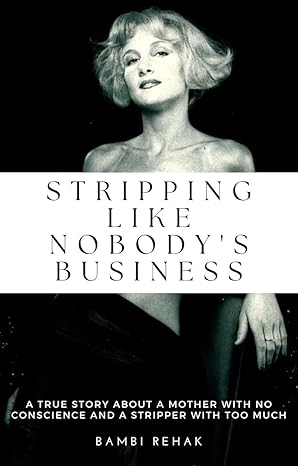
At first glance, the title Stripping Like Nobody’s Business may cause some people to jump to the wrong conclusion. That reaction is understandable in a world where titles are often judged faster than stories are read. But in this case, the assumption would be wrong.
This book is not NSFA. It is not erotic entertainment, and it is not written to be provocative for the sake of attention. It is an autobiography. It is a true story rooted in hardship, survival, motherhood, pain, resilience, and the difficult decisions that can come when life corners a person and leaves them with very few safe choices.
The title reflects a real chapter of the author’s life. That truth matters. But the truth of a person’s work history is not the same thing as the purpose of their book.
If you visit the book page, you will quickly see that this memoir is framed not as fantasy, but as reality. It is about what it means to keep going when life keeps stripping away your comfort, security, and options. It is about surviving circumstances that many people would rather judge from a distance than understand up close.
That is what makes the misunderstanding around the title so frustrating. Some people see one word and assume the content must be explicit. But a memoir is not defined by the most clickable part of its title. It is defined by the life it tells the truth about.
In this case, Stripping Like Nobody’s Business is the story of a woman trying to survive. It is the story of a mother trying to provide. It is the story of a human being navigating poverty, dysfunction, danger, sacrifice, and emotional wear while still trying to hold herself together. That is not NSFA. That is an autobiography.
The title was not chosen to sensationalize. It was chosen because it is honest.
If you read the title disclaimer, the point is made clearly: the word “stripping” is included because it is truthful to the author’s history, not because the website or the book is intended to be erotic or adult entertainment. That distinction should matter to readers. It should matter to platforms, to reviewers, and to anyone deciding whether they are willing to look past a surface-level assumption.
Too often, people flatten women’s stories the second sexuality or sex-adjacent labor enters the picture. They stop seeing the full person. They stop seeing context. They stop seeing struggle. They stop seeing motherhood, fear, humor, intelligence, sacrifice, and endurance. They reduce a life into a label. That is exactly why books like this are important.
A real memoir does not owe anyone neat packaging. It does not need to rename painful realities to make outsiders more comfortable. In fact, softening the truth would only make the story less honest. And honesty is the entire point.
That honesty is part of what gives this book its power. The author is not pretending her life was glamorous. She is not decorating hardship to make it more marketable. She is not asking for pity either. She is telling the truth in a voice that is raw, self-aware, darkly funny, and deeply human.
You can learn more about that voice on the author page, where Bambi Rehak is described as someone who writes from lived experience, not performance. Her perspective was shaped by poverty, instability, motherhood, survival, and the kind of hard-earned self-awareness that only comes from actually living through things many people never have to face. That is what readers are getting here. Not titillation. Not shock bait. Not NSFA material. A life story.
There is also a bigger cultural issue underneath this misunderstanding. People are often comfortable consuming stories about pain as long as those stories arrive in respectable packaging. But when a woman tells the truth with a title that reflects the reality of her own life, suddenly people want to categorize it, sanitize it, or dismiss it before reading it. That reaction says more about society’s bias than it does about the book.
The reality is simple. A book can contain difficult subject matter without being NSFA. A memoir can discuss stripping without existing for erotic consumption. A woman can tell the truth about her life without inviting people to misread her story as adult content.
That is exactly what is happening here.
Stripping Like Nobody’s Business is an autobiography. It is a memoir about survival, resilience, and what it means to endure seasons of life that are painful, unfair, chaotic, and deeply human. It asks readers to look beyond assumption and into context. It asks people to understand the difference between a sensationalized fantasy and an honest life story.
And that difference matters.
Understanding Why This Book Is Not NSFA
So no, this book is not NSFA.
It is not written for arousal. It is not built around explicit entertainment. It is not trying to sell a fantasy.
It is telling the truth.
And sometimes the truth has a title that makes people uncomfortable before they are willing to understand it.
If you want to learn more, visit the book page, read about the author, and take a look at the title disclaimer, which explains the context directly.
Because context is everything.
And this story deserves to be read for what it is, not reduced to what people assume from one word.
If you want, I can also turn this into a more SEO-tuned version with a meta title, meta description, slug, and suggested headings.